RoDTEP rates for farm machinery, by HS code
The rate against every tariff line a farm-machinery exporter actually ships under — implements at 0.9% of FOB, tractors and power tillers at 0.7% — plus the classification traps that put your machine in the wrong chapter, and the 30 September 2026 expiry now sitting six weeks out.
On this page
- What RoDTEP pays on farm machinery
- Soil preparation and cultivation — heading 8432
- Harvesting and threshing — heading 8433
- Sprayers and other machinery — headings 8424 and 8436
- Tractors and power tillers — heading 8701
- Why other rate tables you'll find are wrong
- What it's actually worth
- How to claim it
- Where this sits in the wider export picture
Every farm-machinery manufacturer who exports is entitled to RoDTEP, and most of the ones we work with either do not claim it or claim it against the wrong tariff item. The scheme is not generous — but it is money already earned on shipments already made, and it takes one declaration on the shipping bill to collect.
This guide gives the rate against every tariff line a farm-machinery exporter actually ships under, read directly from DGFT's published schedule. Our Component Sourcing & Trade practice handles this end-to-end for manufacturers who would rather not.
What RoDTEP pays on farm machinery
RoDTEP — Remission of Duties and Taxes on Exported Products — refunds the embedded central, state and local duties on an exported product that no other mechanism refunds. It is paid as a percentage of FOB value, notified per tariff item in Appendix 4R for exports from the Domestic Tariff Area, and in Appendix 4RE for Advance Authorisation, EOU and SEZ exports.
For farm machinery the picture is unusually simple. Every implement line carries the same rate, and tractors carry a lower one.
Crucially, none of these tariff lines carries a value cap. Many RoDTEP lines are capped at a rupee figure per unit of quantity, which quietly limits the benefit on higher-value goods. The farm-machinery lines are not, so the percentage applies to the full FOB value however you price the machine.
Soil preparation and cultivation — heading 8432
This is where most Indian implement exports sit: ploughs, harrows, rotavators, seed drills and planters.
| Tariff item | Description (as per CTH) | RoDTEP rate | Value cap |
|---|---|---|---|
| 8432 10 10 | Disc ploughs | 0.9% | None |
| 8432 10 20 | Other tractor ploughs | 0.9% | None |
| 8432 21 00 | Disc harrows | 0.9% | None |
| 8432 29 10 | Rotary hoes | 0.9% | None |
| 8432 31 00 | No-till direct seeders, planters and transplanters | 0.9% | None |
| 8432 39 00 | Other seeders, planters and transplanters | 0.9% | None |
| 8432 41 00 | Manure spreaders | 0.9% | None |
| 8432 42 00 | Fertiliser distributors | 0.9% | None |
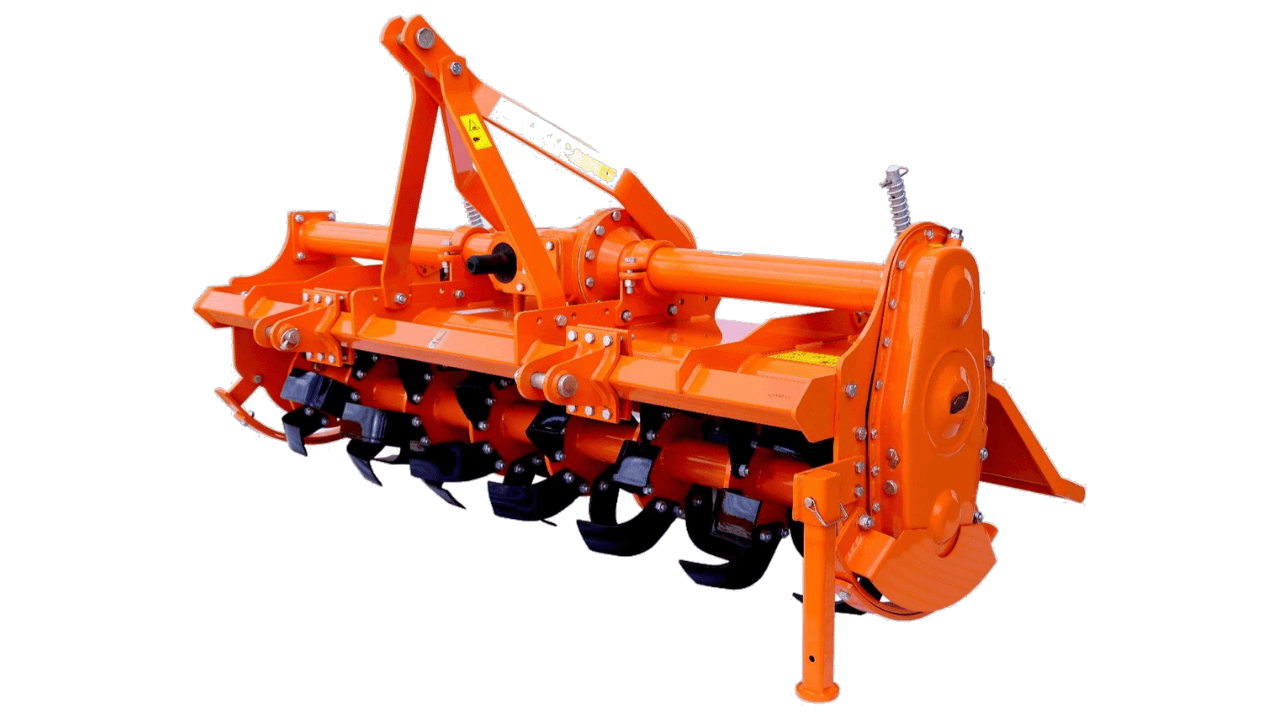
| 8432 80 20 | Rotary tiller — the rotavator line | 0.9% | None |
| 8432 90 10 | Parts of agricultural machinery of 8432 10 / 21 / 29 / 30 / 40 | 0.9% | None |
The line that matters most to Indian exporters is 8432 80 20, "Rotary tiller" — the rotavator. It is a distinct tariff item from 8432 29 10 "Rotary hoes", and exporters routinely use the two interchangeably. Both attract 0.9%, so the money is the same either way, but an inconsistent tariff item between your invoice, shipping bill and any FTA certificate of origin is the sort of mismatch that stalls a scroll-out.
Harvesting and threshing — heading 8433
Threshers, reapers, balers and combines.
| Tariff item | Description (as per CTH) | RoDTEP rate | Value cap |
|---|---|---|---|
| 8433 11 10 | Mowers, powered with 3 HP or more | 0.9% | None |
| 8433 20 00 | Other mowers, including cutter bars for tractor mounting | 0.9% | None |
| 8433 30 00 | Other hay making machinery | 0.9% | None |
| 8433 40 00 | Straw or fodder balers, including pick-up balers | 0.9% | None |
| 8433 51 00 | Combine harvester-threshers | 0.9% | None |
| 8433 52 00 | Other threshing machinery — the multicrop thresher line | 0.9% | None |
| 8433 53 00 | Root or tuber harvesting machines | 0.9% | None |
| 8433 60 10 | Machines for cleaning | 0.9% | None |
| 8433 60 20 | Machines for sorting or grading | 0.9% | None |
| 8433 90 00 | Parts | 0.9% | None |
Note the split between 8433 51 00 and 8433 52 00. A self-propelled combine harvester-thresher goes under 51; a stationary or tractor-driven multicrop thresher — the far more common Indian export — goes under 52. Same rate, different line.
Sprayers and other machinery — headings 8424 and 8436
| Tariff item | Description (as per CTH) | RoDTEP rate | Value cap |
|---|---|---|---|
| 8424 41 00 | Portable sprayers | 0.9% | None |
| 8424 49 00 | Other agricultural or horticultural sprayers | 0.9% | None |
| 8424 82 00 | Agricultural or horticultural spraying appliances | 0.9% | None |
| 8424 90 00 | Parts | 0.9% | None |
| 8436 10 00 | Machinery for preparing animal feeding stuffs | 0.9% | None |
| 8436 80 90 | Other agricultural machinery not elsewhere specified | 0.9% | None |
| 8436 99 00 | Parts | 0.9% | None |
Battery and knapsack sprayers are a significant small-manufacturer export line, and they sit across 8424 41 and 8424 82 depending on construction. Both are 0.9%.
Tractors and power tillers — heading 8701
Here the rate drops, and the chapter changes.
| Tariff item | Description (as per CTH) | RoDTEP rate | Value cap |
|---|---|---|---|
| 8701 10 00 | Single axle tractors — the power tiller line | 0.7% | None |
| 8701 91 00 | Tractors not exceeding 18 kW | 0.7% | None |
| 8701 92 00 | Tractors exceeding 18 kW but not exceeding 37 kW | 0.7% | None |
| 8701 93 00 | Tractors exceeding 37 kW but not exceeding 75 kW | 0.7% | None |
| 8701 94 00 | Tractors exceeding 75 kW but not exceeding 130 kW | 0.7% | None |
| 8701 95 00 | Tractors exceeding 130 kW | 0.7% | None |
Note also that the tractor lines from 8701 91 to 8701 95 are banded by engine power in kW, not by horsepower. A 45 HP tractor is 33.6 kW and falls in the 18–37 kW band under 8701 92 00, not the 37–75 kW band. Indian datasheets almost always quote HP, so this conversion is a routine source of misclassification.
Why other rate tables you'll find are wrong
RoDTEP rates for machinery moved twice in 2026, and most of what is published online has not caught up.
| Date | Notification | What changed |
|---|---|---|
| 01.05.2025 | No. 10/2025-26 dated 26.05.2025 | Appendix 4R realigned to the Customs Tariff as amended by the Finance Act 2025. Code changes affected Chapters 10, 20, 29, 38 and 71; rates and descriptions otherwise unchanged, so Chapters 84 and 87 carried over. |
| 23.02.2026 | No. 60/2025-26 | RoDTEP capped at 50% of notified rates, and 50% of notified value caps, for everything outside ITC-HS Chapters 1–24. Farm machinery, being in Chapters 84 and 87, was hit. |
| 23.03.2026 | No. 66/2025-26 | The 50% restriction withdrawn. Rates and caps as applicable on 22.02.2026 restored. |
| 31.03.2026 | No. 74/2025-26 | Scheme extended 01.04.2026 to 30.09.2026, Appendix 4R and 4RE rates and caps unchanged from 31.03.2026. |
The practical upshot: the 50% cut is gone, and the rates in the tables above are the ones in force. A number of well-ranked pages still present the cut as current, because they were written in the four-week window between the two notifications and never updated. If you have been told your rotavator line pays 0.45%, that was true for those four weeks and is not true now.
What it's actually worth
RoDTEP will not change the economics of an export order. It is worth collecting because it costs one declaration.
| Consignment | Tariff item | Rate | RoDTEP benefit |
|---|---|---|---|
| ₹50,00,000 of rotavators | 8432 80 20 | 0.9% | ₹45,000 |
| ₹50,00,000 of multicrop threshers | 8433 52 00 | 0.9% | ₹45,000 |
| ₹1,00,00,000 of tractors | 8701 92 00 | 0.7% | ₹70,000 |
| ₹25,00,000 of knapsack sprayers | 8424 82 00 | 0.9% | ₹22,500 |
For a manufacturer shipping ₹5 crore a year of implements, that is roughly ₹4.5 lakh — against zero incremental cost, since the scrip is issued off paperwork you are already filing.
How to claim it
The declaration step is where this most often goes wrong for smaller manufacturers, particularly those exporting through a merchant exporter or a freight forwarder who fills the shipping bill on their behalf. If nobody has explicitly told the forwarder to claim RoDTEP against each line, it does not get claimed, and there is no recovering it later.
Where this sits in the wider export picture
RoDTEP is one piece of export readiness, and the easiest one. The harder gates are on the conformity side — a machine that cannot be legally placed on the destination market earns no incentive at all, because it never ships. Our guides on BIS certification for farm machinery and tractor and farm machinery homologation cover the Indian side of that; the destination-market side is a separate problem, and a bigger one.
Frequently asked questions
- 0.9% of FOB value for agricultural implements — everything under ITC-HS headings 8432 (soil preparation and cultivation), 8433 (harvesting and threshing), 8436 (other agricultural machinery) and 8424 (sprayers). Tractors and power tillers, which sit under heading 8701 in Chapter 87 rather than Chapter 84, earn 0.7% of FOB. None of these tariff lines carries a per-unit value cap, so the rate applies to the full FOB value of the consignment.
- 0.9% of FOB. A rotavator is classified under tariff item 8432 80 20, described in the schedule as 'Rotary tiller'. Note that this sits in heading 8432 alongside ploughs, harrows and seed drills — and is a different tariff line from 8432 29 10 'Rotary hoes', which some exporters use by mistake. Both attract 0.9%, so the rate outcome is the same, but a wrong tariff item on the shipping bill causes scrutiny at scroll-out.
- 0.7% of FOB, not 0.9%. This is the classification trap that catches the most exporters. A power tiller is a self-propelled machine and is classified as tariff item 8701 10 00, 'Single axle tractors' — in Chapter 87 (vehicles), not Chapter 84 (machinery). It therefore earns the tractor rate of 0.7%, while the rotavator it tows earns the implement rate of 0.9%.
- No. DGFT Notification No. 60/2025-26 dated 23 February 2026 capped RoDTEP at 50% of notified rates and value caps for everything outside ITC-HS Chapters 1 to 24 — which included all farm machinery. That restriction was withdrawn by Notification No. 66/2025-26 dated 23 March 2026, which restored the rates and caps applicable on 22 February 2026. Many pages still online describe the 50% cut as current. It is not.
- 30 September 2026, as things stand. DGFT Notification No. 74/2025-26 dated 31 March 2026 extended the scheme from 1 April 2026 to 30 September 2026 with the Appendix 4R and 4RE rates and value caps unchanged from 31 March 2026. RoDTEP has been extended repeatedly before, so a further extension is plausible — but it is not automatic, and the FY 2026-27 allocation of about ₹10,000 crore is well down on the previous ₹18,233 crore.
- No separate licence. You claim it on the shipping bill itself by declaring your intent to avail RoDTEP against each item, then the benefit is issued as a transferable electronic scrip (e-scrip) in your ledger on the ICEGATE portal after the shipping bill is scrolled out. The critical point is that the declaration must be made at the time of export — you cannot go back and add it to a shipping bill afterwards.
- Yes. RoDTEP e-scrips are freely transferable and can be used to pay basic customs duty on your own imports or sold to another importer. Because the farm-machinery rates are modest, most manufacturers who do not import components themselves end up selling the scrips, typically at a small discount to face value.
- Yes, but from a different schedule. Appendix 4R carries the rates for exports from the Domestic Tariff Area. Exports by Advance Authorisation holders, EOUs and SEZ units are covered by Appendix 4RE, which was notified separately and carries its own rate lines. Check 4RE rather than 4R if you fall in any of those categories.

Devendra K Jha· Director, AgriMachinery Consulting
Engineer-leader and founder of AgriMachinery Consulting. Works with India's small and unorganised farm-machinery manufacturers on certification, homologation, subsidy empanelment, supply chain and dealer-network strategy from offices in Pune and New Delhi.
- Farm-machinery certification & homologation
- SMAM / state subsidy empanelment
- Manufacturing & supply chain